
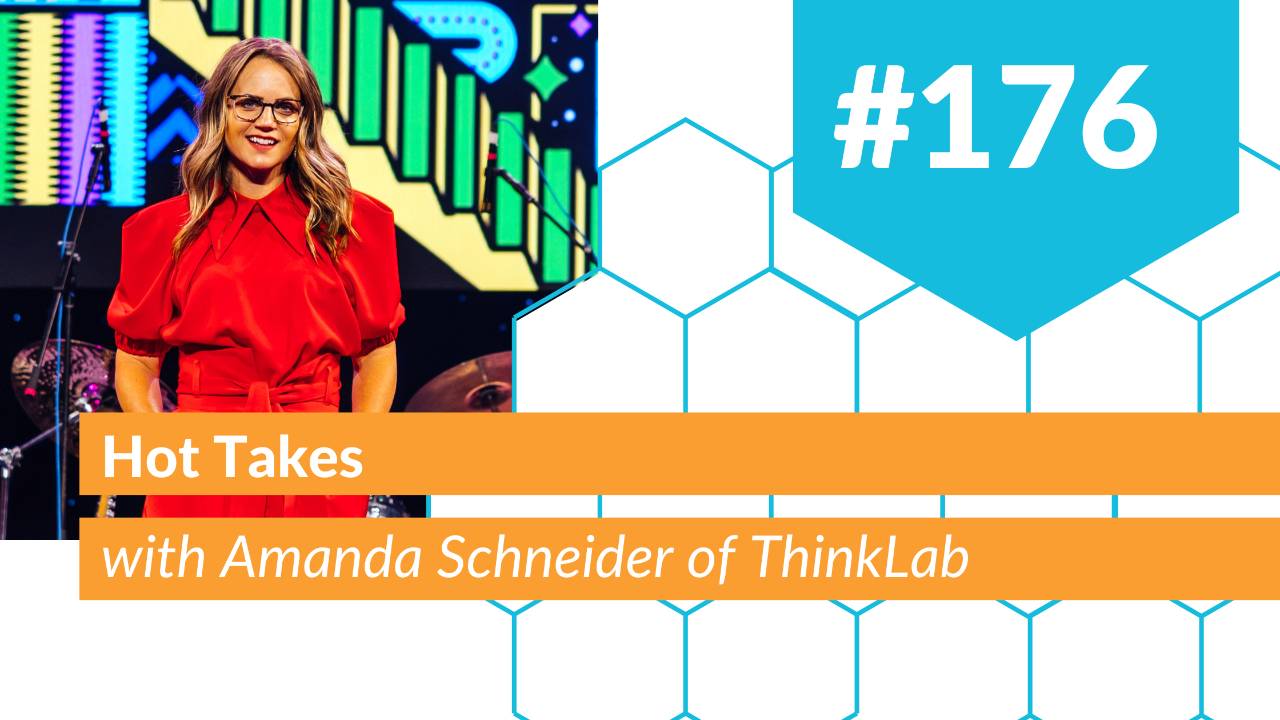
That’s the spirit behind our Hot Takes episodes. No prep. No polished slides. Just a wheel of questions and real-time reactions. And when your co-host is Amanda Schneider, you know you’re not going to get surface-level answers.
Amanda is the Founder and President of ThinkLab, the research division of Sandow Design Group. She spends her days immersed in data, behavior shifts, generational change, and the evolving relationship between physical and digital space. She also recently delivered a TED Talk that has now surpassed half a million views and is preparing to launch her book, Work for What’s Next.
So when the wheel landed on the question, “What do we really sell?” I knew we were about to get something good.
Amanda believes most of our industry gets this wrong. She argues that we think we are selling product. Chairs. Flooring. Lighting. Systems. But in her view, that framing is far too narrow.
She believes we are selling a better future for the people who work, heal, and live inside the spaces we help create. And more than that, she believes we are selling ease.
Ease in the process. Less friction. Less risk.
Amanda has long argued that the biggest disruptions in our industry will come from process innovation, not product innovation. In a world where thousands of products look and perform similarly, the real differentiator is how simple you make the journey for your customer.
In her words, the question becomes: how are you selling "easy?"
That perspective reframes everything. Because if we are honest, most clients are not losing sleep over gauge thickness or threaded metal inserts. They are losing sleep over deadlines, budgets, risk, and whether this decision will make their lives harder or easier.
When the conversation shifted to leadership, Amanda’s answer felt equally relevant to this moment in time.
She believes we are living in an era of time famine. Everyone is managing their energy more intentionally. Stress is high. Risk aversion is real. In that environment, she argues that great leaders reduce stress rather than add to it.
How do you remove friction from your team’s day? How do you help them conserve energy instead of draining it? Leadership, in her view, is not about adding more expectations. It is about creating clarity and reducing unnecessary tension.
She also shared something that struck me deeply. In an era defined by rapid change, one of the most important skills a leader can develop is the ability to rethink and unlearn. The world is evolving faster than ever. What worked five years ago may not work today. Knowledge still matters. Experience still matters. But asking better questions matters even more.
Amanda sees this clearly in her research work. When she presents large industry studies, she often asks participants what surprised them most. Ninety percent of the time, people point to something that confirmed what they already believed to be true.
That insight should give all of us pause.
If we only look for validation, we stop learning. We defend our tribe. We dig into our position. And we miss the gray space where real innovation lives.
That thread connects directly to the bigger conversation Amanda is leading around the future of work. Through her research, her TED Talk, and now her upcoming book, she is exploring how generational shifts, digital transformation, and cultural expectations are reshaping workplace culture. She believes our industry has been thinking about these changes for years, and now the broader world is finally paying attention.
The opportunity for us is not just to react. It is to lead.
Even the lighter questions revealed something meaningful. When we joked about dress codes, Amanda pointed out that designers often wear black on black on black. It is understated. It lets the design speak. And if you want to stand out, wear color.
There is a metaphor in there. In a sea of sameness, sometimes differentiation is as simple as showing up differently.
By the time we landed on the final question about books, the conversation had moved into something deeper. Amanda shared that she is currently reading The Righteous Mind, a book that explores why good people are divided by politics and religion. What fascinates her is not the controversy. It is the psychology of tribal thinking and our tendency to defend what we already believe.
That pattern shows up everywhere. In leadership. In business. In generational debates. In return to office conversations. In how we think about the future of work.
The lesson is not that we abandon conviction. It is that we stay curious.
Hot Takes episodes are designed to be unscripted. But what stood out to me in this conversation with Amanda is how consistent her throughline remains. We are not just selling products. We are shaping experiences. We are not just leading teams. We are managing energy. We are not just navigating change. We are being asked to rethink what we thought was settled.
If there is one thread that connects all of it, it is this. The future will belong to those who reduce friction, ask better questions, and stay open to what they have not yet considered.
So here is the question worth sitting with.
In your business right now, are you defending what you already believe or are you curious enough to rethink what might be next?