The Trend Report Podcast
Hot Takes with Kay Sargent of HOK
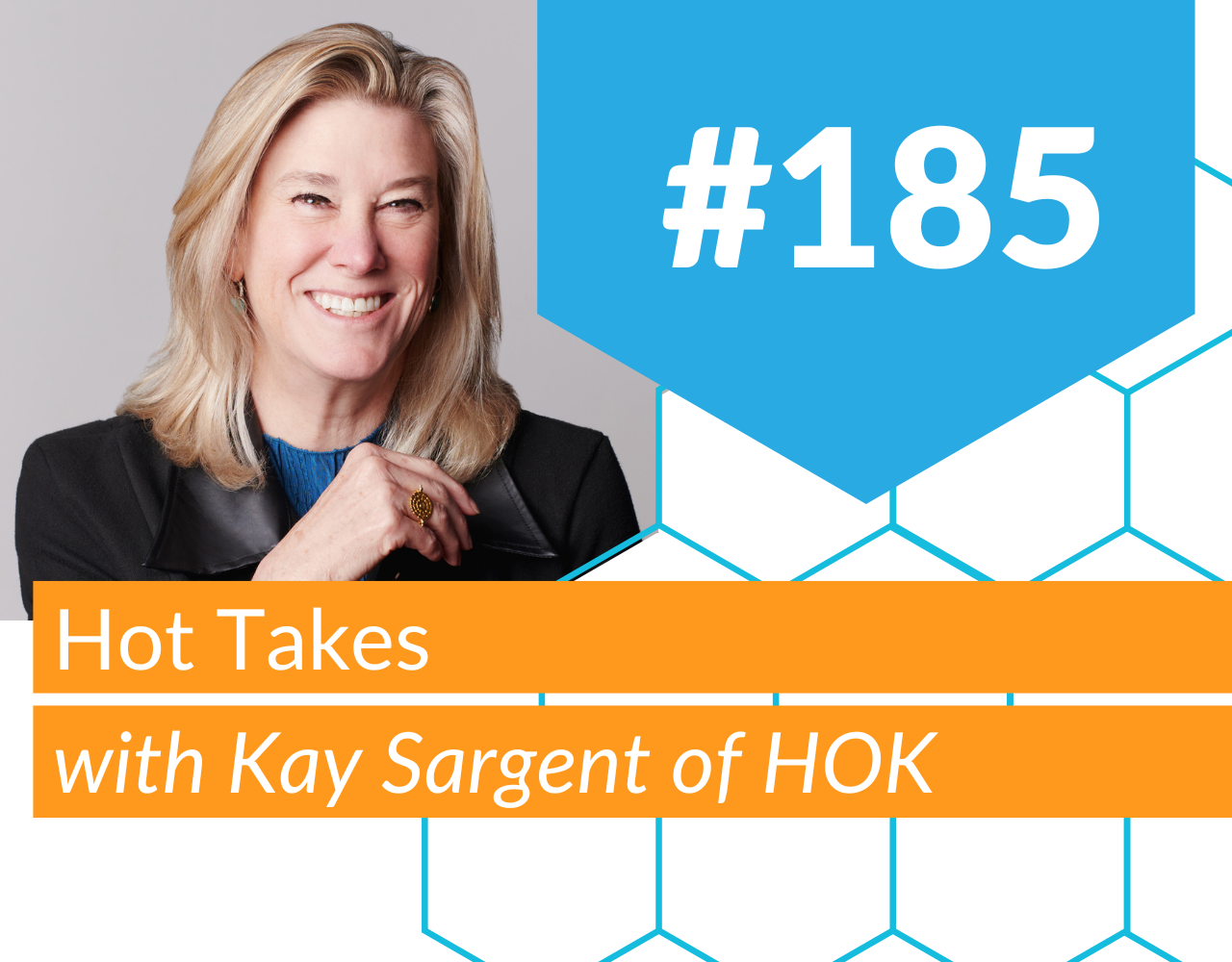
SPEAKERS
Sid Meadows, Kay Sargent
Intro:
Have you ever wanted to pick the brains of an industry leader or an influencer or someone who's shaping the future of our industry? Or maybe someone who's been in the trenches for a while and has real thoughts and opinions? Well, today we're going to do just that.
Meet Kay Sargent And Her Role
Sponsor:
We'd like to thank our presenting sponsors, Avanto, services and software that streamline how you operate and the collaborative network, a platform where leaders in the contract interiors industry unite.
The Collaborative Network Ad:
If you're leading sales, marketing, or growth in the contract interiors industry, you already know this work can feel isolating. So that's why we built the Collaborative Network. It's a peer-driven community for manufacturers and leaders who want real conversations, real accountability, and practical insight, not generic advice. No posturing, no sales pitches, just experienced people working through real challenges together. If you're ready to grow smarter, check us out at thecollaborative.network.
Sid:
Welcome back or welcome to the Trend Report, your inside look at the people, products, and ideas shaping the future of workplace design. I'm your host, Sid Meadows, and I'm glad that you've tuned in for another edition of our hot take series, where I'm joined by a co-host. We spin the wheel of topics and share our unscripted hot takes in real time. And my guest or co-host today needs really no introduction, but please join me in welcoming to the show Kay Sgt. Hey Kay, how are you? I'm great, dude. Thanks for having me. Well, it's been a minute. I should say welcome back because, and I should have looked this up. You were a guest in season one of the podcast, which would have been 2020. And that's a long time ago.
Kay:
I love that. And I love the fact that you're gonna, you said you're gonna pick the brain. Whatever. I'm not sure how much is left up there, but you just pick away. It's okay.
Sid:
For those people, trust me, uh, it's gonna be fun. For those people that don't know you, briefly tell us who you are and what you do.
Kay:
Sure. I am a practicing designer of over 40 years. I'm the mother of five kids. I am the director of thought leadership for interiors at HOK, which is one of the world's largest architectural firms. I uh focus on a lot of topics, uh neurodiversity. We do a lot of foresight, we do workplace, artificial intelligence, all the things that are impacting our clients today that they want to know about so that they can be future ready. And so I spent a lot of time doing that and traveling around the world talking about it.
Sid:
So explain for us just for a brief moment, what is the director of thought leadership? What does that actually mean? That's a really good question. This is not part of the wheel, by the way, but Right.
Kay:
Yeah. So for years, I, you know, I mean I mean I've kind of gone through practicing designer, project management, director of ops, interiors, you know, all those things. Uh, I led our workplace team for a while, which is all of our big corporate clients that have millions of square feet of space all over the world. But really, what we found is they want to know what's happening and what's coming. And so we tend to spend a lot of time really focusing on what are the things that are important for our clients that they need to be thinking about that they may not be thinking about. So that's what I do as director of thought leadership is answer a bunch of questions about anything and everything our clients want to know. That's awesome. And congratulations on the book. Was it last year that you published the book on neurodiversity and design? God, it feels like a decade ago. But yes, it was just last year. That's great. And how's the book going? It's going well. We actually just had the last official book launch a year later. So I don't even know if you can call it a launch a year later. But it's been great. We've been in multiple cities, had lots of different conversations, and it's found a really interesting audience that I could not have anticipated. You know, whether it's families, whether it's operational therapist. Uh it's been really exciting and really interesting. And it's great to see that every sector within HOK healthcare, sports and rec, justice, hospitality, airports, they've all picked up on it and created their own versions and are running with it, which is absolutely fabulous.
Sid:
That's awesome. Well, I'm excited for you to be here today. I really appreciate you giving us a quick little update as to Kay, but are you ready to dive in? Are you ready for this? I I don't know if I'm ever ready, but let's do it. So I showed her the wheel a minute ago and she goes, oh, it's like a real wheel. Like it's a real wheel. All right, let's get started. There's some really good ones, and I hope there's some that are really relative to you, but I don't control where they land. So we're gonna hit the spin button and see what happens.
Kay:
All right, let's do it.
Sid:
All right, so our first question we're gonna try to get to four is so we've had this one before, and I thought I had removed it, but Kay, if you tell me like how much you really want to add to this question, but are dealers today more strategic partners or order takers? Because I don't know how much are you involved with dealers today?
Kay:
Yeah, no, we are. Uh they should be strategic partners because they are the linchpin in everything, right? There's a big corporation, there's a big manufacturer, but the dealer is the one that is delivering everything. I fear that in a time where things are going very quickly, everybody wants everything fast, designers are really being pinched, that designers are treating dealers like order takers, but I think that that's a mistake. How do we change that? Well, they shouldn't be doing our jobs for us. We should be doing our jobs. And number two, we need to leverage their expertise and their talents. And they're in a really difficult situation because they don't want to say no to the design community. But I think in many times there are certain firms that are asking them to go way beyond what they should be doing and doing parts of their job. But it is really about the delivery, the connection. So they should be a very strategic partner.
Sid:
And I'm going to agree with you. I'm going to call them the glue. They're the glue that connects the manufacturer to the end user. And they are the front line for all of the manufacturers out there. And they're the ones that are managing the complexity because every job has some level of complexity with it. And so I do believe they're continuing to evolve to be more strategic partners, but there are those that just take orders. And I am resisting from asking you tons of follow-up questions because this is not an interview show. This is a spin the wheel. But we'll come back to that later. Well, I just like there's so many questions there, especially about the design community, working with the dealers, and how do we get more involved and become better partners and those kinds of things, but we're not going to do that because this is we're spinning the wheel. So we're going to spin and get another question. We're going for four. We may get five today. So we'll see.
Kay:
Let's see if we can get six, but we'll see. Okay.
Sid:
Okay. This actually affects everybody in our industry. So, Kay, why do you think that we have a hard time recruiting new and young people to the industry as a whole?
Kay:
Because we don't perceive it as a viable career path early enough in their childhood. So every child enters uh kindergarten thinking they're an amazing artist. Everybody builds with blocks, but somehow Sir Kenneth Robinson talks about how creativity is beaten out of children in our school system. And architecture and design are not presented as really viable career paths early enough so that people can decide they want to go into it. I can't tell you how many college students come to me and say, Oh, you know, I decided I wanted to go into architecture design like halfway through. I never really realized that was a path. And especially interior design, the way that it is represented, if at all, in high school is so pathetic that it actually does the industry a disservice.
Sid:
So, and those are great points. And I think part of it is, and I'm going to tie to it, I heard Rex Miller talk about that creativity stat that you talked about in the very beginning of the answer about how we the behavior we taught not to be creative, starting around kindergarten or whatever. And I think it's really fascinating. But we're not an industry that is talked about on college career day. Whether it's furniture, fabrics, carpet, interior design, architecture, we're just not talked about. We're not there. And I think it's incumbent upon us as an industry to show up. We got to be there. We got to tell people about this industry and all of the different roles that you can hold inside of the industry because it's not just sales or interior design. There's marketing, there's manufacturing, there's engineering, there's graphics. There's so much.
Kay:
And the role the role models in media are pretty weak and very excited. No, no, no, no, no. I mean, like in television shows or HGTV, right? This whole notion of, oh, I can create something overnight and it's, you know, wizardry, and it's, you know, I don't think it is giving our industry a fair shake about what it really is.
Sid:
I would agree with that. The media has portrayed it in a way that, you know, I think my daughter started out in interior design. And interestingly enough, she ended up moving to fashion, but which is really where she should have been. But in high school, so she's 15, going into her freshman year, they are required to pick a path. And she picked interior design. She didn't know much about it. What she knew about it was what she had seen on TV. Right. Now she stayed in that path all through high school, but I can tell you, once she got into some of the mechanics of it, like she hated using AutoCAD. She hated drawing things, right? Like that. Well, I'm so glad that she found fashion. There, there you go. But you know, I think the schools could do a better job at helping like explain what are the roles inside of our industry that people can access because there's tons of them. And this is a fun place to work.
Kay:
It's great. It's a really fun industry, you're right.
Sid:
And did you ever think that you'd be doing thought leadership when you got your design degree?
Kay:
I've done things in my career I could have never imagined. Never. I I did security design, I got paid to break into buildings, I helped write ADA, I designed master plans for military bases, I've designed courthouses, courtrooms. I mean, I've designed everything you can imagine, and I never could have thought about that early on.
Is Buying Furniture Now Too Confusing
Sid:
And again, I think that goes to we need to talk more about what we do and what is possible inside of our industry. I'm gonna bring on uh somebody who designs parking lots and have a real discussion. Okay. All right, so the next question is are we making it harder for our customers to buy from us?
Kay:
I think it's more confusing. And if you're if you're stuck in a certain rut, I think 10 or 15 years ago, our clients were very used to going to one manufacturer, buying everything from them because 70 to 80 percent of what they were buying were rows and rows of paneled systems, and then a little bit of ancillary or auxiliary or ancillary product. There's the word I'm looking for. But now it's more complicated. And there are more manufacturers and more product, and a much higher percentage is coming into that ancillary type of furniture. And so I don't think we're making it harder. I just think it is more complicated because it's not just this go to one person and they have everything, and 90% of it is this, and that's the discount. And so if you're stuck in that model of mindset, then yes, you absolutely think it's harder.
Sid:
Yeah, and I'm agreeing with you on this because I also think when you really start to dive in, there's thousands. The statistic that I heard was over 3,000 manufacturers in our industry. Of those three, that's a lot, right? But of those 3,000, only 10 of them are large. The other two, let's call it other, let's make let's say there's a hundred that are large. The other for easy math for me, the other 2,900 are small businesses, and which is great because they all bring something unique to the table and something different to the table. But I do think we're adding complexity to the process. I think we're adding complexity to the some of the products that we specify when we should be trying to figure out how to take complexity away and make it easier. And at the end of the day, does the customer really care about the brand that they're buying or the solution that they're buying? I think it's the solution.
Kay:
I'd also say that many people, when they ask me about what is the workplace of the future, what they're really asking me is, are you gonna is somebody going to come out with something that's gonna make everything I just bought obsolete? You know, how am I spending my money? So I think the whole way that we procure furniture for the period of time that we do it and then the afterlife, while we could talk for hours about that, I think is really broken. And I think we need to be coming up with better options and solutions for our clients.
The One Sales Question That Matters
Sid:
There's some good questions around that topic on this. We'll maybe we'll get to one. Let's try to try another one. I've lost count how many we've done already, but we're gonna go for three. This is four. We'll we will get to six then for sure. All right, next question. Oh, do you have a favorite sales question?
Kay:
What do you value? Oh everybody right now is so focused on productivity or this or that. We're not asking the right questions. And the question is, what is it that you actually value? What do you actually want? Do you value furniture that will last for 20 years? Do you value a workspace that will uh encourage people to collaborate? Do you value, you know, what is it that you value? And I'm gonna tell you, most of our clients, when we ask them that question, have to stop and think about it because they're not really sure. Like, do you value spaces where everybody comes in, sits at a desk, and is spending 90% of their time responding to email? Or is there something else you want your people to do? And if so, if you value something different, then we should be designing differently. That's my favorite question.
Sid:
I love that. That is a really powerful question. And so I am gonna give a different question. Obviously, my answer is gonna be different. But my favorite question is what problem are you trying to solve in your business? Yeah. Like I want to understand like what's the real problem that they're having because I believe when we ask a question like that, we actually uncover more opportunities to solve more problems or sell more product and services to that client by trying to understand the problem they're trying to solve when they're buying furniture.
Kay:
Yeah. I I think it's we just basically did the yin and the yang, the the positive and the kind of looking at it from the different angle are basically the same question.
Sid:
Well, we need to learn to ask better questions and understand why people are buying. And I would say to the listener, you know, if you go to the website at sidmeadows.com on the right hand side of the screen, there's a little red box that says leave us a message. I would love for you to go over there and leave us a message and tell us what's your favorite sales question. Like, tell me what's your favorite question to ask your customers when you're out there talking to them.
Sponsor:
We'd like to thank our supporting Silver sponsors, KISP, who helps furniture brands visualize and sell products before specification. Navitas Credit Corp. Navitas makes great workspaces affordable, turning furniture projects into easy monthly payments. Web Configurator Services, the leader in AI-powered online product configuration and quoting.
KiSP Ad:
Selling contract furniture is getting harder. You're dealing with complex products, disconnected tools, and buyers who make decisions before you ever get to spec. KISP helps fix that with clean product data, visual sales tools, and expert visualization services built for the way furniture actually gets sold. Backed by 30 years of experience, KISP helps dealers and manufacturers visualize, configure, and get chosen early before specification ever starts. To learn more, visit www.KISP.com.
WCS Ad:
Let's be honest, selling contract furniture has gotten complicated. Between product options, pricing rules, and back and forth emails, quoting can slow everything down. And when quoting slows down, deals slow down. That's where WCS comes in. They offer web-based CPQ configurators that combine visualization, real pricing logic, and instant quote generation so your team, customers, and sales reps can configure correctly and quote immediately. If you're a manufacturer looking to simplify how you sell, check out webconfigurator.net and request a free demo.
Sid:
This is number five, right?
Kay:
Yep, number five.
Thought Leadership Needs Shared Language
Sid:
Okay. All right. Oh. Okay. This is great because of what your role is at HOK. No, this is so the question is, is individual thought leadership important? Okay, take it away.
Kay:
Yes, but if you keep it to yourself, it's the best kept secret and it doesn't help. And what we really need to be doing, we need to have individuals that are sparking ideas and thoughts. Innovation kind of like germinates by itself, but then it grows and when it comes together. And so I think what we need to do is have uh opportunities in platforms, whether it's conferences or professional associations, where people can bring those things together and say, here's what I'm thinking, what are you thinking, or what are you seeing? And so, like, we have a ton of roundtables with our clients to share this is what we're seeing. How do you guys feel about this? You know, how is it impacting you? They learn something, we learn something, everybody around the table learns something. And so yes, but it's a first step and take it to the next level.
Sid:
So I'm gonna agree with you. Our industry needs more voices. We need more voices, not sharing the same thing other people are sharing, but sharing their original thoughts and their original ideas to help solve problems that exist in our industry, because every industry has problems, we have problems, and we can solve them collectively. But if you don't share, if you don't share your thoughts on a topic, then nobody's gonna know what it is. So that's kind of to your point. You gotta share it.
Kay:
Okay, but let me just say this our industry is really struggling right now because everybody is putting things out there without really collaborating on them with other people. And so there's 10 different versions of what the same word means, yeah, because everybody is just making it up and then throwing it out there, and it's confusing the market because we don't have a common language or common terminology and define it the same way. Do you have an example of that? Like flex space. Okay, for some people that's coworking. For other people, that's hot desking or free choice. For other people, it's preset suites. So that one term has multiple different definitions depending on who you're talking to. How are our clients ever supposed to understand what we're talking about if we're all using different terms for different things?
Sid:
So the bottom line is individual thought leadership is important, meaning the individual person needs to that means creating content. A lot of people don't want to create content, but it's also equally as important for the brands to take a leading role in thought leadership and not just selling.
Kay:
Yeah. And and look, some people are just coming up with dumb terms just to be different, and that's not helping either, right? Like let's be intelligent about what it is that we're doing. And the goal is to should be to clarify, not confuse. And we're confusing.
Sid:
But if you don't share your thoughts, nobody's gonna know them, and it's actually not thought leadership if you're not sharing.
Kay:
That's true.
Sid:
Okay, let's do another one.
Kay:
Thank you for justifying my position.
Consolidation And Choice Overload
Sid:
I fell into the world of thought leadership. Like I fell into it, and I thought nobody wants to hear my opinion. All right, let's get a good one here. Question number six. Okay, this is actually a really good one, and I want to take it up beyond the term that's on this screen. So the question is, is dealer consolidation good or bad for the industry? Let's frame that as is consolidation good or bad for the industry? Because it's happening at the dealer level, the manufacturing level, and a lot of other places.
Kay:
Well, I'm gonna I'm gonna address it at the dealer level first because I think there's a huge difference. Organizations tend to be global, manufacturers tend to be regional, maybe global. Dealers tend to be local. They are the linchpin. Okay, so you you've got two big global international companies and a linchpin right in the middle, which is just local. Most of our clients want partners that can service them wherever they are. And that has always been a challenge with the dealers that are just being in one market. So the fact that we now have multiple dealers that have multiple locations in multiple regions or states, I actually think is good because that's what our clients and customers want. So from expansion, I think is a is a great thing. Manufacturers consolidating, buying each other, et cetera, can be good. And it can be bad. It can streamline, uh, give you an economy of scales. It can streamline certain things, it can pool some of your resources, it can get rid of some of the redundancies and markets, etc. On the other hand, it can also, if certain people become too big, then they can stamp out some of the competition. So it depends on the responsibility with which you yield that.
Sid:
Oh, those are great answers. So consolidation is here, it's happening. I've yet to really form an opinion whether I think it's good or bad. I'm watching it and I'm trying to pay attention to it. I do understand that strategic dealer growth into a marketplace to support their alignment, because that's mostly where you see it is with the major alignment brands and be able to expand the alignment in those key marketplaces. If the dealer is willing to take the risk, then I think it's good because it is a risk. If your corporate headquarters is in Chicago and your office is in Miami, there's risk associated with that, right? Yeah. And so I think if you're saying and cost. Oh, yeah. Gosh, yeah. Yeah. Yeah. Yeah, absolutely. But I understand your point, especially for the Fortune 500 that's operating in multiple markets and working with potentially the same dealer across those markets. When I was a global account manager at Hayworth, that was always the big topic of how we're going to support the customer across their portfolio. So, you know, but manufacturing consolidation to me is interesting. I love it when I see smaller brands consolidate, either one by the other, they merge together to expand their portfolio. Because as a huge advocate for small businesses, that's helping the small businesses grow and expand their reach and maybe go into markets where one brand hasn't been and the other one has been. But when you see these massive acquisitions like with Miller Knoll and Steelcase and HI, it brings a lot of questions to me about how big is too big. The redundancies that exist with basically the same unused panel as an example, but basically the same panel system from three or four different brands. When do you decide to consolidate them? When do you decide to merge them together?
Kay:
I actually am really surprised in some of those cases. I thought early on that they would take maybe one line and make it more about like the high-end bespoke product and the more residential and hospitality, and the other, the other one would go the other direction because they all have a little bit of both, right? It's hard to be a luxury brand when you're also at the bottom of the pile. You kind of have to decide. And I think everybody's trying to be everything for everyone. And I don't necessarily think that's a great strategy. I think a better strategy is to say, okay, we've got this brand that's really, really good in these markets. And this one, let's get rid of the ying, and let's just focus on the really good. And this one, you know, is the yin to that yang. And so they're going to focus on this. And so you had two brands that are coming together with different value propositions, capitalizing on what each one of them is bringing to the table that they succeed in, and you focus on that. If you're just basically saying we're going to keep your yaki stuff too, and it's going to compete with this, these guys' stuff, I I don't think that's a great model.
Sid:
So I saw this video the other day of somebody talking about selecting chairs from a brand that has consolidated with another brand. Okay, I won't name them because I'll get in trouble. But if I'm a seller of that particular brand and it's for a task chair to go into an open plan, I have 25 choices. Why? Why does that brand offer 25 choices of a chair that basically does exactly the same thing with similar features and they look really close to each other and maybe they're all mesh back? Like, why as a brand do I need that many options? And why do I need to give my dealers and customers that many choices?
Kay:
Yeah, the argument would be features and price point, but you still don't need 25.
Sid:
No, um, let's simplify things. All right, we're gonna go one more time, Kay.
Kay:
Let's do it. Let's go for seven.
AI Will Reshape Work And Design
Sid:
One more time. No, no, we're breaking records here today with K Sargent. All right. All right, last question. Oh, this is a good one. I just added this one today. So, what's one thing that will shape the future of the industry over the next five years?
Kay:
I I hate to even say it, but it's just the obvious answer and it's the unknown, and it it has, you know, just such wide-sweeping things. But but AI. AI is really, I think, you know, you think about the fact that ChatGPT has only been around for three years. And I think we are in a race with technology, uh, Stephen Hawkins once said about uh how quickly it will evolve and the wisdom with which we use it. This will absolutely change the way that we ideate, it will change the way we manage, it will change the way that we create things in a good way and in a bad way. And I think we need to be really, really intentional about this, and it's gonna change our business, and I think we need to be prepared for that.
Sid:
So how are you seeing AI implemented in the interior design community?
Kay:
It's helping with time management, it's helping with, you know, there's three kinds. Okay, so we we kind of look at this like there's the operational side. Yep. There's the analytical side, and there's the generative side. So the operational side, building management, operations, we've been doing that forever. Analytical side. I get a 500-page RFP, go through here and tell me what are the main things that are important, what are the things I can, you know, I have to do, you know, helping you analyze things. Written word. Uh, we are not using it for generating the written word. We are looking at it to polish the written word because I could talk with about that for hours, about the problems and the challenges with that. Uh, but we have clients that are handiness images that they created with generative AI and saying, this is what I want it to look like. And right now, as an industry, generative AI can create amazing looking things. It will not tell you how a person who you're really designing for will feel and function in that space. And that is where our expertise is still so important and valued. And we need to lean into the science of design to say, yeah, that might look good, but here's the reasons why that wouldn't function well for you, like the flooring, that's the ceiling, you know, the acoustics, you know, all of those things. So it's if all we're doing is thinking about what looks good, then we're no better with somebody with generative AI. As a profession, we have to pivot to a genetic orchestration, where we are leveraging it to help get rid of some of the things that are dull or you know, monotonous or to help refine things and can help analyze things, but we have to use our intelligence, expertise, and our training to be able to really help still set things apart and determine what is right for our clients and not. Not just what looks good, but what will function well.
Sid:
What is it that you value and what problem are you trying to solve? Like mic drop right there. I need a mic drop sound on my board over here because that's on point. And I agree with you. Five years ago, I wouldn't have obviously said AI, but obviously with the you know, the advent of it coming out in the last three years, with really even though we've been using AI for a long time, open AI really put it on the map for everybody. And then it just exploded from there. And it is literally a daily thing. Like it's every day we there's something new with it, right? But I think it's about to your point, Kay, how are you using it? And telling it to go and do something for you. Let's just use write an article. Go write an article for me about neurodiversity and design and use K Sargent's book as the bullet points for this. Okay, it can do that. Does that have any CID in that? No, it doesn't, right?
Kay:
Yeah, but Sid, let me let me just use your example. Okay. So at one of the book launch events, somebody came up to me and said, Oh, I read your book last night. I'm like, You read the whole thing last night? Uh that's pretty impressive. And he goes, Well, I had ChatGPT do a download for me and it gave me kind of the cliff notes. And I said, Really? That's not reading a book. He goes, Yeah, I can ask it anything about your book here. Watch. And so it asked a question. And it asked, you know, does K, what does Kay say about her son in her book? And within, you know, five seconds, there's a whole little paragraph. And I'm reading this, and I'm like, wow, this is this is kind of my God, I don't remember writing that. It was so articulate that it had me questioning whether I had put that in the book or not. And I'm like, wait a minute, that's not true. I wouldn't have put that in the book because that's not true. And he said, Really? So he took it back and he said, Can you fact check that and tell me if that's 100% accurate? And then it came back and said, Well, that's not exactly what Kay says in the book, but it's something like what she would say in the book. So if I hadn't questioned it, he would have believed that that was true and it wasn't. And then he would have shared it. Yeah. ChatGPT will give you an answer 100% of the time. It will never be 100% correct.
Sid:
Right.
Kay:
And I think that's if you don't understand it at a deep enough level to question it, then be careful what you're asking because you don't know whether you're going to get the right thing or not. Well, I'm an enthusiast with AI.
Sid:
Like I love learning about it. I will, I'm not trying to be an expert, but I'm trying to learn because I get asked about AI on a regular basis, right? So I'm trying to really learn about it. And I want to pay attention so that I can, you know, be able to help answer questions. And I've learned how to talk to, I use ChatGPT. I've learned how to talk to it a little bit. I've learned a little bit, a lot. I've learned how to get it to cite its sources and where that information is coming from. I'm reading a book right now called The AI Driven Leader by Jeff Woods, which talks about how to use it as a thought partner, not the thought leader. You're the thought leader, let it be your partner. Like, and I love brainstorming with ChatGPT. I love saying, like, interview me, ask me questions. Because the important part here is that if I'm going to do something that I'm going to put out in the public, that I'm part of that. So the best way to do that is for it to interview me and to hear my thoughts and to then incorporate that into the into the topic. So it's a great book. Oh, interesting. I love it. Yeah, we're using it a lot, but cautiously. Yep. So you haven't implemented it across the across your portfolio yet?
Kay:
Oh, in many ways we have. I mean, there's we have we have tools that we are using and and you know, but we are being very strategic. The other thing I think that we're very cautious about is look, we have a lot of information about our clients. And we, you know, once you put that in there, it's out for the world to see. And so we are very, very protective about our clients' information and what we are putting into that because we did never want to compromise any of that.
Sid:
Yeah, that I talked about that in the first episode, I think, of this season with Hunter Jensen from a company called Barefoot Solutions. And we talked about policies, governance policies, being secure with the information that you're sharing. It's so very important that you're you're using a private AI and not a public AI. And you can create your own private version so it's behind your security so that you're not teaching and sharing confidential information with the world. That's about it.
Kay:
Yeah, I think that's really critical. I just think, you know, most, I think we're dumbing into a lot of stuff that we don't really understand the full ramifications of. And I think it's got great interesting potential for the next few years. It's the longer-term trajectory that I'm much more cautious and I lose sleep about.
AI Risks Fact Checking And Data Security
Sid:
So I gotta tell you, we could keep talking, but we're not going to because that's all the questions. And we broke a record, we got to seven questions. Kay, I cannot thank you enough for being here today and coming in and being brave and spinning the wheel and hot taking with me. If our community would like to get in touch with you, what is the best way for them to do that?
Kay:
Oh, they can follow me on LinkedIn uh or you know, Kay.Sargent@HOK.com
Sid:
Super easy. We'll drop all that in the show notes. Just remember if you reach out to her, let her know that you heard her here on the trend report in 2026, not in 2020 when she was on. And I was really not a great podcast host back then. But thank you again. Thank you again, K for being here.
Sponsor:
We'd like to thank our community bronze sponsors, Catalyst Consulting Group, RESEAT, and Staffing Plus.
Catalyst Consulting Ad:
Public sector sales don't happen by accident. They happen by strategy. At Catalyst Consulting, we help small business manufacturers break into and grow within federal, sled, and cooperative contract markets. With over 100 years of combined experience selling to the public sector in the commercial furniture industry, we know what it takes to compete and win. We help you align with the right contracts, the right partners, and the right opportunities. Government sales are complex. Your strategy shouldn't be. Visit strategic-catalyst.com and take our Pathfinder assessment to see where you are on your public sector path.
Outro:
Thank you for joining us today and being part of the Trend Report, your inside look at the people, products, and ideas shaping the future of workplace design. Go out there and make today great, and we will see you right here in the next episode. Take care, everyone.